

Industry association leaders visited Jiangsu Meizilin Nanotechnology Co., Ltd.
Focus on nanoscale dispersion technology and its industrial application
Focus on nanoscale dispersion technology and discuss the application of chemical fiber industry
On September 10th and 16th, 2026, Vice President Li Lingshen of the China Textile Industry Federation and President Chen Xinwei of the China Chemical Fiber Industry Association visited Jiangsu Meizilin Nanotechnology Co., Ltd. They exchanged views on nanoscale dispersion technology, chemical fiber raw material coloring, ultra-fine fiber coloring, functional granules, bio-based fibers, and industrial textiles applications.
PART01 Association Visit | Focus on Technological Innovation and Technology Transfer
The two visits focused on technological innovation and technology transfer
On September 10th, Vice President Li Lingshen visited the company and listened to an introduction of Meizilin's nanoscale dispersion technology, raw material coloring masterbatch, and functional masterbatch research and development and industrialization. They also discussed topics such as technology transfer, application verification, standard testing, industrial chain collaboration, and market expansion for industrial textiles.
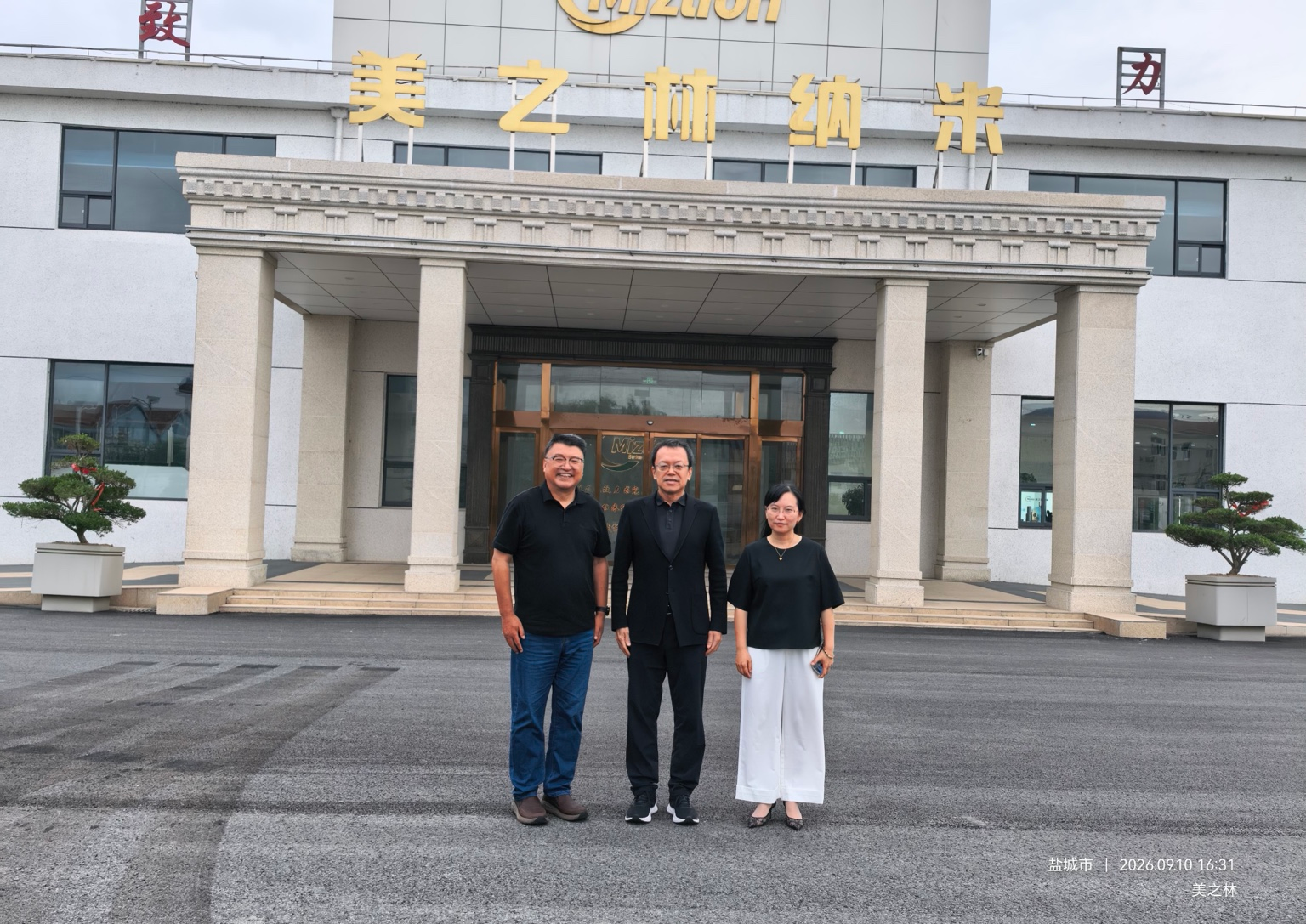
Vice President Li Lingshen during the visit
On September 16th, President Chen Xinwei conducted the visit and exchange, focusing on Meizilin's research progress in PP, PET, PA6, PA66, and PLA fiber masterbatch and functional masterbatch fields. Both sides had in-depth discussions on issues such as 1D and below ultra-fine fiber raw material coloring, dark color fiber spinning, high color fastness, flame retardant function, and PLA spinning performance.

President Chen Xinwei during the visit
The two visits respectively focused on the professional development of the chemical fiber industry and the collaborative development of the entire textile industry chain, further clarifying the application direction of nanoscale dispersion technology in high-quality raw material coloring, functional fibers, and industrial textiles.
During the visit, Meizilin introduced the company's research achievements in PP, PET, PA6, PA66, and PLA fiber masterbatch and functional masterbatch fields, and focused on reporting the progress of nanoscale dispersion technology in ultra-fine fiber raw material coloring, dark color fiber spinning, high color fastness, and functional fibers.
As fibers continue to develop towards ultra-fine, high-speed, and functionalization, the particle size of color masterbatches, filtration performance, melt compatibility, and batch stability have become important factors restricting product upgrading. Meizilin has continuously carried out technological research on these issues, forming a technical system from colorant screening, nanoscale dispersion, interface coating, carrier matching to spinning verification.
Eight technological progressions form a systematic capability:

These technological progressions are not the simple improvement of product performance, but rather a systematic application capability formed around ultra-fine fibers, dark coloring, flame retardant safety, bio-based materials, and functional composites.
PART02 Technological Breakthrough | Ultra-fine Fibers, Dark Coloring, and Functionality
Breakthrough in the application boundaries of ultra-fine fibers and dark coloring
Extending from conventional fibers to 1D ultra-fine fibers
Conventional 2-3D fibers use raw material coloring relatively maturely. When the single filament fineness drops to 1D and below, tiny agglomerated particles may cause increased filtration pressure, shortened component cycle, increased fuzz and breakage. Meizilin uses nanoscale dispersion, interface coating, and carrier matching to extend raw material coloring to 1D PET, PA6, and PA66 fine denier and ultra-fine fibers.
This technology can serve imitation suede, peach velvet, brushed fabric, ultra-soft home textiles, sports fabrics, underwear, socks, and high-performance wiping materials, and helps reduce the reliance of some products on post-processing dyeing.
High proportion addition promotes dark raw material coloring
Dark black, dark blue, and high saturation fibers require a high proportion of color masterbatch addition, which poses comprehensive tests on melt rheology, filtration performance, fiber strength, and continuous spinning stability. Meishilin achieves deep color and high saturation coloring while maintaining spinning stability and fiber physical properties by improving dispersion performance and carrier compatibility.
High color fastness expands the durable application market.
Through colorant screening, nano-dispersion, interface coating, and spinning process optimization, the raw material colored fibers and fabrics of Meishilin can achieve a washing fastness of 5 grades and a light fastness of 7-8 grades under corresponding test conditions. This capability helps expand the markets for outdoor textiles, automotive interiors, sunshade materials, home fabrics, and industrial textiles. The specific performance should be based on product models, addition ratios, test standards, and third-party reports.
Functionalization and bio-based materials develop in tandem
Flame retardant technology for safety applications
To address the flammability and potential molten droplet issues of PP fibers and non-woven fabrics, Meishilin developed flame retardant functional masterbatches and corresponding processes. Under suitable formulations, addition ratios, and specified test conditions, the flame retardant properties of PP and PET materials can be enhanced and self-extinguishing can be achieved even when the flame is removed. The relevant solutions can be applied to curtains, wall coverings, carpets, automotive interiors, rail transit interiors, filtration and sound insulation materials, and ultimately the performance should be verified on the finished fibers or fabrics.
PLA-specific systems improve continuous spinning
Due to the sensitivity of PLA to moisture, heat history, and processing temperature, Meishilin improved the dispersion, compatibility, and continuous spinning stability of PLA color masterbatches through dedicated carriers, low-temperature dispersion, interface compatibility, and moisture control, providing support for the development of multi-color, deep-color, and functionalized bio-based fibers.
PART 03 Technological Progress Expands Application Scope in the Fiber Industry
Continuous dyeing enters more challenging fields
Nano-dispersion technology extends continuous dyeing from conventional fibers to ultra-fine fibers, deep-color fibers, and high-performance functional fibers, upgrading from general color solutions to an important component of high-end spinning technology.
Products evolve from single coloring to color and function combination
Colors can be combined with flame retardant, anti-aging, anti-static, water repellent, hydrophilic, antibacterial, cool sensation, heating, mosquito repellent, mite repellent, and far-infrared functions, promoting fiber enterprises to develop differentiated products for sports, outdoor, health, automotive, construction, and industrial textiles.
Production methods transition to cleaner and digitalization
The combination of color crystal technology and automatic metering systems helps improve feeding accuracy, color change efficiency, and batch stability, reduces dust and human errors, and promotes the development of small-batch, multi-variety production towards standardization, automation, and traceability.
Procurement evaluation shifts to comprehensive spinning costs
The value of high-performance color masterbatches should be comprehensively considered, including filter component cycle, breakage rate, waste rate, color change time, production efficiency, fiber strength, color fastness, and post-processing costs, promoting the industry to shift from comparing color masterbatch unit prices to evaluating the entire process cost and terminal product value.
Collaboration in the industry accelerates technological成果转化
Ultra-fine fiber continuous dyeing involves colorants, carriers, dispersion processes, spinning equipment, filter components, weaving, and fabric evaluation, requiring verification by color masterbatch enterprises, fiber enterprises, research institutions, testing institutions, and end brands, forming a collaborative innovation mechanism for the market.
PART 04 Application Implementation, Market Pathways, and Industry Outlook
Key fabric and industrial textile application tables:

Outdoor sunshade and building textiles cannot be judged solely by UPF for anti-aging life. UPF reflects the ability of the fabric to block ultraviolet rays. Long-term outdoor use also requires tests such as xenon lamp or fluorescent ultraviolet aging, thermal aging, and mechanical performance retention rate. The automotive, rail transit, medical and health care fields also need to complete corresponding regulations and terminal product verification. The key market implementation paths are determined based on the maturity of technology and the degree of differentiation. Meizilin can prioritize the promotion of PET and PA ultra-fine denier dark color clothing fabrics, automotive and rail transportation flame-retardant interior materials, outdoor shading and building weather-resistant materials, flame-retardant curtains, wall fabrics, carpets, PP functional non-woven fabrics, and PLA biobased textiles in six markets.
Market development should adopt a joint development approach involving color masterbatch research and development, spinning verification, fiber testing, weaving samples, and fabric testing, with the final fabric performance as the evaluation basis, to form replicable product models, addition ratios, process windows, and test reports.
Exchange and evaluation on future directions
During Vice President Li Lingshen's visit, both parties exchanged views on the transition of scientific and technological achievements from the laboratory to large-scale application, strengthening standard and testing support, and promoting the upstream and downstream collaboration of chemical fibers and industrial textiles.
During the exchange, President Chen Xinyue affirmed Meizilin's commitment to nanoscale dispersion technology innovation, overcoming the problem of original liquid dyeing of ultra-fine fibers, and promoting the green, comfortable, and functional development of chemical fiber materials. The two visits further clarified Meizilin's development direction of continuous research on ultra-fine, dark-colored, functional, and biobased materials.
We sincerely thank the industry association for its continuous attention and support to Meizilin! In the future, Meizilin will strengthen collaborative innovation with industry associations, research institutes, chemical fiber enterprises, textile enterprises, testing institutions, and end brands, and improve the technical service system from color masterbatch research and development to fiber and fabric application.
Meizilin will provide more stable, efficient, and environmentally friendly raw liquid dyeing and functionalization solutions to promote the development of chemical fiber materials towards finer single fibers, deeper colors, higher color fastness, and more application scenarios, continuously empowering the high-quality development of the Chinese chemical fiber industry.
- Focusing on ultra-fine fiber col
- Expanding Industrial Textile Mar
- Adapting to Multiple Spinning Co
- Ruizhen Color Masterbatch: Resha
- Colorful and ingenious, exquisit
- Embrace the subtle, weave the co
- Exhibition Invitation | Rizhe Pi
- Expanded Downstream Applications
- How Non‑woven Functional M